
 Previous
"Thursday is the best day of the week.鈥� With those eight words, the president of Seattle General 吃瓜头条 吃瓜头条, in Washington state, closes our Thursday morning meetings. His unstated premise: These meetings make this day of the week special.
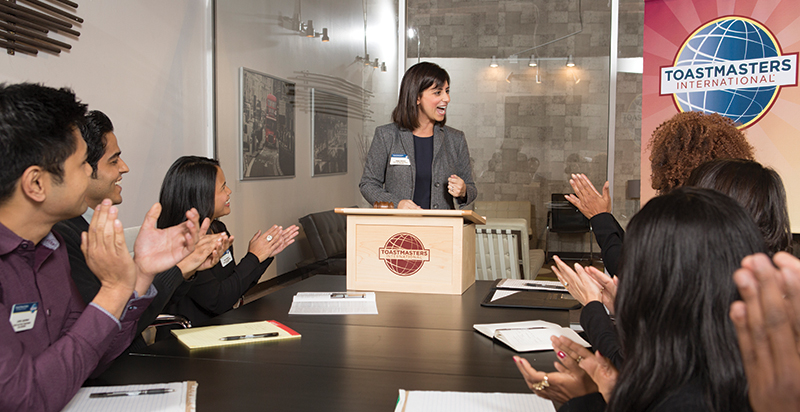
Hyperbole? Sure. But it鈥檚 no exaggeration to say that Seattle General 吃瓜头条 is a highly successful 吃瓜头条. It has operated continually since its founding in 1945. Its roster usually hovers around 30 members and its meetings routinely draw 18 to 20 attendees.
These high-energy meetings, which serve as a valuable tool for turning guests into members, are no accident. Rather, they鈥檙e the product of the seven strategies our 吃瓜头条 employs, some, or all, of which other 吃瓜头条s can profit from.
Develop an effective scheduling model.
Your scheduling model should enable the scheduler to assign members to meeting roles fairly and give them sufficient time to prepare for the roles or find replacements.
Our 吃瓜头条 uses 鈥渟elf-scheduling,鈥� which works like this: All 吃瓜头条 members can access the 吃瓜头条鈥檚 website on Google Docs. Every two months, our scheduler posts a fill-in-the-blank form on the website that asks members to schedule themselves by a cutoff date.
The form covers two months in advance, which in effect gives 吃瓜头条 members two months鈥� notice of future meeting roles. 颅Members unable to attend a meeting can use the website to indicate their unavailability.
After the cutoff date, the scheduler fills in the blanks with the names of members who didn鈥檛 schedule themselves or notify the scheduler of meetings they won鈥檛 attend.
Give participants additional notice of their roles before a meeting.
It happens at every 吃瓜头条. A member signs up for a role or speech in an upcoming meeting and forgets about it. This can be particularly troublesome when the forgetful member is a scheduled speaker who then becomes hard-pressed for time to properly prepare a speech. And a poorly prepared speech weakens a meeting.
This is why the Toastmaster should contact everyone on the schedule no less than four or five days before a meeting to confirm that they’ll attend the meeting and be prepared to perform their roles. Members should be reminded that if they can’t attend a meeting, it’s their responsibility to find a replacement for the role they were to play.
Get things moving.
Seattle General 吃瓜头条 accomplishes this in two ways. First, after opening the meeting, our president calls on the “early bird,” a role our 吃瓜头条 has created to lead us in some form of physical or mental activity. For example, we may be directed to take a walk around the room or do a yoga stretch. The person holding the early bird role then provides a brief quote or two as food for thought.
High-energy meetings, which serve as a valuable tool for turning guests into 颅members, are no accident.
What typically happens next is the president informs us it’s national “something” day or week or month. Let’s say it’s National Pigs-in-a-Blanket Day. (Honest, there is such a thing.) The president says, “Please stand, state your first and last name, and in a sentence or two tell us why you like or dislike pigs in a blanket.” One by one, all present—guests included—stand, state their names and briefly respond to the president’s question.
These introductions give members without a role an opportunity to speak. Together with the physical activity, our 7 a.m. meeting is off to good start.
Choose a memorable theme.
A theme provides structure to a meeting. Virtually all of our 吃瓜头条 meetings have a theme, which is chosen by the Toastmaster. Themes can be serious (favorite teacher), humorous (dumbest TV series) or quirky (worst teenage date)—it’s the Toastmaster’s call. From this, the Topicsmaster can create topics tied to the theme.
Before each meeting, our Toastmaster crafts a question he asks of all participants, and during the meeting, each response is woven into each individual introduction.
Be professional.
I’ve never attended a play or a musical that began on time. But a 吃瓜头条 meeting is not a theatrical event. Failure to start a meeting on time or finish within a certain time frame projects a less-than-professional image of your 吃瓜头条. Guests are not impressed by that kind of image.
Also unprofessional is when a speaker or other participant significantly exceeds his or her time limit. At Seattle General 吃瓜头条, once an individual exceeds the maximum time, our timer strikes a small gong. Wrap up quickly, it warns the offender. Those gonged become ineligible to compete for a first-place ribbon in their role category.
Make sure guests 鈥渇eel the love.鈥�
Every 吃瓜头条 吃瓜头条鈥攁nd Seattle General 吃瓜头条 in no exception鈥攅xperiences attrition. To remain viable, a 吃瓜头条 must compensate for member losses by converting guests into members.
When you add a large dose of laughter to a meeting, the event becomes more lively, more fun and, yes, more unforgettable.
Many 吃瓜头条s do a decent job of welcoming guests, but Seattle General 吃瓜头条 enhances the welcome by taking the following steps. First, we offer each guest a chance to participate in Table Topics鈥攏o arm-twisting, just a soft sell. Second, at the end of a meeting, we ask guests for their reaction to the meeting. Finally, we explain to guests how manual speeches build speaking skills, and we show them copies of 吃瓜头条 manuals.
Laugh, laugh, laugh.
As we 吃瓜头条 know, humor is often appropriate—even in a serious speech. So, also, is humor at a 吃瓜头条 meeting. At Seattle General 吃瓜头条 we laugh a lot—some might say we howl. We’ve found that when you add a large dose of laughter to a meeting, the event becomes more lively, more fun and, yes, more unforgettable.
How do you foster laughter? A good place to start for our 吃瓜头条 is when the president opens the meeting (See strategy number 3). Another good place is the theme-related introductions the Toastmaster uses when introducing the speakers (See strategy number 4). Another good time to introduce laughter is during Table Topics. But your 吃瓜头条 needn’t follow our template. For example, your 吃瓜头条 could create a “jokester” role, whose job it is to start each meeting with a joke. Once you start laughing at a 吃瓜头条 meeting, it’s hard to stop.
Over time, our 吃瓜头条 has found that these seven strategies reinforce one another and add valuable energy to our meetings. In turn, the meetings produce a climate of excellence, which leads to improved speeches and evaluations and better meetings. Adopt one or more of these strategies, and before long, your 吃瓜头条 will be able to say that its meeting day is the best day of the week.
Paul Freeman, ATM a semiretired freelance writer, is a member of the Seattle General 吃瓜头条 吃瓜头条 in Seattle, Washington.
 Previous Article